A marathon runner’s training plan starts from race day and works backward. Build an aerobic base, introduce tempo runs, sharpen race-pace intervals, then taper as race day comes close.
Every session is designed to produce peak performance on a specific date. Elite runners accumulate over 100 kilometers per week (roughly 80% easy, 15% moderate, 5% race-intensity), shifting to a more polarized distribution as the race approaches1.
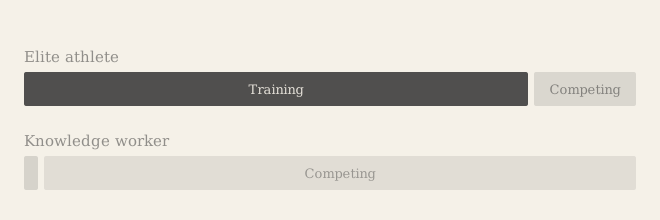
Your median knowledge worker does not train. They ship: Code, meetings, email, decisions, all day, every day. No periodization, no base-building, no taper, and no plan. We assume our everyday work is part of our training.
However, it is not. Ericsson shows that observed performance does not correlate just with experience, but specifically through deliberate practice2. Through a routine of hard cognitive labor, keeping your mind performing at the edge of your ability, you can do feats of cognition that no one has ever achieved.
If we keep repeating what we’ve learned before, we become stochastic parrots, losing our human creativity, adaptability, and unpredictability.
Backtracking from race day
For athletes, the demands of competition determine the structure of preparation. A sprinter and marathoner both run, but their training programs share almost nothing (heavy squats vs. long slow runs). The race dictates the training, not the other way around.
Knowledge workers rarely ask the equivalent question: What is my race, and what does it demand of me?
As a founder, the race is a sequence of high-stakes decisions under uncertainty along with long stretches of execution. Your training is not to execute more; it’s to study cases of success and failure from the past, maintaining conviction under uncertainty, and building mental reserves to sustain judgment when you are exhausted. A great example of transferring athleticism into knowledge work is Zinsser’s A Confident Mind, treating confidence as a trainable skill, built through deliberate practice3.
As a researcher, your race is to create novel insight. Your training is to read outside your field, learn adjacent methodologies, and deliberately sit with hard problems before reaching Claude Code.
As an engineer, your race is building systems that work under real-world pressure. The training is studying systems that failed, learning domains you do not currently need, and practicing specification and decomposition on problems where no one is waiting for the output.
In each case, the training mind does things the competition mind never does directly. The legionnaire trained with equipment that was two times heavier than their actual equipment. The founder writes blog posts but never references them at work.
The goal is to make competition mode easy by training hard.
The body is not optional
Athletes protect their minds despite training their bodies. Similarly, mind workers must protect their bodies while training the mind.
Athletes who sleep less than eight hours per night are 1.7x more likely to get an injury. Reaction time and accuracy improves as you sleep up to ten hours4. Sports improves cerebral blood flow and synaptic plasticity5. The body becomes the difference between a mind that can sustain four hours of hard thinking and one that fades after two.
Physical difficulty ultimately trains the same capacity the hardest problems demand: Continuing when you want to stop. Many knowledge workers treat their body as a vehicle for carrying the brain and is surprised when both stop performing.
What keeps you stuck
A hidden threat in working with your mind is that plateaus are much more difficult to distinguish. For an athlete, the plateau is tracked and measured, and when they reach one, they identify and solve the limiter, unlocking performance.
Example limiters for knowledge work may be a workspace that invites distraction, a morning routine that puts you in reactive mode before doing anything generative, tool use that has not been optimized to reduce brain cycles, a calendar full of other people’s priorities, and an undefined relationship with your phone.
Don’t trust willpower. Identify and remove. Where does time go that produces neither training nor competition value? Eliminate or automate it. The released hours is where elite performance lives.
Tracking
An elite athlete does not guess whether they are improving. They measure. As an athlete, you measure resting heart rate, heart rate variability (which has severe consequences for cognition as well6), and sleep quality every morning. Training load, rate of exertion, performance against benchmarks every session. They know when a signal is red, and they adjust.
Almost nothing is tracked in knowledge work. At the end of the day, you usually think about whether the day was “productive,” which usually means whether it was busy. This is like an athlete judging their training by how tired they feel: Correlated with quality, but loosely, and sometimes inversely.
What should a knowledge worker track daily?
- Time-to-focus. How fast can you switch to deep work from any other work? When it’s longer, the environment or routine is at fault. The average is 23 minutes after an interruption7.
- Deep work hours. Not hours at the desk, but hours of actual demanding output. Even top performers max out at 3-4 hours of deep work per day8. If you work 14 hour days, there’s a high chance only 2-3 hours are truly valuable. Asana showed that 60% of workday time goes to coordination, with just 27% left for strategic output8.
- Decision log. What decisions did you make today, what information did you have, what was your confidence level? Review monthly. You will find patterns: the decisions you made tired were worse, the ones where you ignored a nagging doubt were wrong, the ones you made after morning base work were sharper. This is how you calibrate judgment.
- Energy curve. When in your day is your thinking sharpest? Most people have a strong opinion but haven’t actually tested the exact hours. Working against your chronotype has significant deficits9.
- Training input. What did you produce or study that was not directly related to a deliverable? If this row is empty for a week, you are in pure competition mode and your base is eroding.
The point isn’t to build a dashboard. It’s to calibrate your perception of what a bad day and a bad trend looks like. Subjective feel is unreliable.
Stimulants
Athletes take legal performance-enhancing drugs when they compete but stay clean during training. Otherwise, they are unable to measure their real baseline, recovery rate, and capacity. The difference between the podium and the field becomes the 3.2% performance improvement from caffeine10.
Strategic non-habitual use produces the most reliable benefit while habitual use has variable returns11. Knowledge workers usually use stimulants daily to sustain a baseline that should not need sustaining. Dependencies mask problems in sleep, recovery, or training load. Never operating without chemical support means you do not know your baseline.
If we follow the athlete’s approach, we should do our morning base work without caffeine and then use it strategically for high-stakes afternoon sessions and deadlines. If you use stronger tools (modafinil, nicotine, etc.), never confuse the drug’s performance for your own.
The goal is not abstinence, it is self-knowledge. You cannot improve what you cannot measure.
The method
An athlete’s week has structure: What to train, when, how hard, and when to rest. Here is our equivalent.
Morning, 60 to 90 minutes: Base work. Read something difficult, unrelated to today’s work. Only primary sources. Take notes in Obsidian or by hand to connect it to what you already know. This is to build the aerobic base of your thinking. Once a week, replace with deep study in an adjacent field (two to four hours). This is cross-training. Make sure these blocks are done unaided by chemicals to know what you’re capable of.
Midday, four to six hours: Race pace. This is competition. Protect this block from reactive inputs. Strategic caffeine use here.
Before dinner, 20 minutes: Game film. What worked, what failed, and what surprised you? Record one thing you did well and one thing to improve. Log time-to-focus, deep work hours, and energy curve.
Physical, 45 to 60 minutes: Strength work. Some of the highest benefit/hour is deadlifting. Hard enough that you practice not quitting. You train for the same capacity through a different modality.
Weekly, half a day: Taper. No inputs, let adaptation happen during rest. Creative breakthroughs follow the same pattern. Darwin walked the same route every morning.
The ratio is roughly 20:80, training to competition. Far less than an athlete’s 95:5. But infinitely more than the 0:100 that most knowledge workers run, which is a strategy for being average in a world where average is about to mean replaceable.1213
The athlete’s mind is not a metaphor. It is a method.
-
Casado et al., “Training Periodization, Methods, Intensity Distribution, and Volume in Highly Trained and Elite Distance Runners,” International Journal of Sports Physiology and Performance, 2022. The competitive period sees a shift toward a more polarized distribution as intensity increases and volume decreases. See also: Frontiers in Sports and Active Living, 2023. ↩
-
Ericsson, Krampe & Tesch-Römer, “The Role of Deliberate Practice in the Acquisition of Expert Performance,” Psychological Review, 1993. Expert performers counteract automaticity by developing increasingly complex mental representations to maintain control over performance. Mere experience explains very little variance; structured practice at the edge of current ability explains most of it. Updated in Ericsson (2019), Frontiers in Psychology. ↩
-
Nate Zinsser, The Confident Mind: A Battle-Tested Guide to Unshakable Performance (HarperCollins, 2022). Zinsser directs West Point’s Performance Psychology Program and has mentored Eli Manning (two-time Super Bowl MVP), NHL All-Stars, and Olympic medalists. His method includes confidence journals (daily written evidence of competence), mental rehearsal of specific scenarios including failure modes, and what he calls a “mental bank account” of accumulated wins. The technique of pre-game visualization translates directly: The founder rehearsing the fundraise that goes sideways, the engineer rehearsing the system redesign that hits an unexpected constraint. Athletes schedule this psychological training alongside physical work because both degrade without maintenance. Knowledge workers leave it to chance. ↩
-
Watson, “Sleep and Athletic Performance,” Current Sports Medicine Reports, 2017; Halson, “Sleep in Elite Athletes and Nutritional Interventions to Enhance Sleep,” Sports Medicine, 2014. Stanford basketball study (Mah et al., 2011): extending sleep to 10 hours improved sprint speed and shooting accuracy by over 9%. Survey of nearly 900 elite athletes: sleep named the single most important recovery tool regardless of sport or competitive level. ↩
-
Erickson et al., “Exercise training increases size of hippocampus and improves memory,” PNAS, 2011 (12-month RCT, 2% hippocampal volume gain). Meta-analysis of 54 RCTs in Feter et al., Ageing Research Reviews, 2023: aerobic exercise improved global cognition, resistance training improved executive function. The mechanism involves BDNF production, increased cerebral blood flow, and enhanced synaptic plasticity in the prefrontal cortex. ↩
-
Luque-Casado et al., “Applying HRV to Monitor Health and Performance in Tactical Personnel,” Frontiers, 2021. fMRI-verified causal links between vagal HRV and prefrontal cortex activity governing attention, decision-making, and working memory. Plews et al. (2013) demonstrated HRV monitoring protocols for Olympic and World Champion athletes. ↩
-
Gloria Mark, UC Irvine research on attention, published in “The Cost of Interrupted Work” (2008) and Attention Span (2023). After an interruption, it takes an average of 23 minutes to fully regain focus. People switch activities on screen every 47 seconds on average. ↩
-
Ericsson et al. (1993): top performers in cognitively demanding fields max out at roughly 3.5 to 4 hours of deliberate practice per day. Cal Newport, Deep Work (2016): estimates align with Ericsson. Asana Anatomy of Work Report (2022): 60% of knowledge worker time spent on coordination; 27% on skilled strategic output. ↩ ↩2
-
Facer-Childs et al., “The effects of time of day and chronotype on cognitive and physical performance,” Sports Medicine - Open, 2018. Early chronotypes peak roughly 5-6 hours after waking; late chronotypes around 11 hours after. Systematic review in Chronobiology International (2025) confirms a “synchrony effect”: cognitive performance is consistently better when matched to chronotype. ↩
-
Ganio et al., “Effect of caffeine on sport-specific endurance performance: a systematic review,” Journal of Strength and Conditioning Research, 2009 (mean improvement 3.2% ± 4.3% in time-trial studies). Goldstein et al., ISSN Position Stand: Caffeine and Exercise Performance, Journal of the International Society of Sports Nutrition, 2021 (updated): confirmed ergogenic at 3-6 mg/kg, with roughly 74% of elite athletes using it competitively. ↩
-
The tolerance question is genuinely unresolved. Lara et al. (2019): the ergogenic effect may be reduced or eliminated after 28 days of consecutive use in some studies. But Goldstein et al. ISSN Position Stand (2021) states the ergogenic effects “are generally independent of habitual caffeine use.” Multiple cross-sectional studies find habitual and non-habitual users show similar performance gains from acute doses. The mechanism for tolerance (upregulation of adenosine receptors) is real, but the performance impact is inconsistent across individuals. See: Filip et al., “Inconsistency in the Ergogenic Effect of Caffeine in Athletes Who Regularly Consume Caffeine,” PMC, 2020. ↩
-
A note on cooperation: Humanity’s superpower is cooperation. Performance at the highest level is a team output, even in individual sports. Knowledge workers chronically underestimate this, with a notable exception in founders. Assembling a team, aligning it under uncertainty, and sustaining collective effort through setbacks is not a soft skill. It’s the hardest of them all. ↩
-
AI and cognitive atrophy: As AI tools handle more of the execution layer, staying on top of your game becomes more important than ever. Research on AI dependency identifies three mechanisms of cognitive decline: critical thinking atrophy, writing skill degradation, and knowledge acquisition reduction, with 32.7% of heavy AI users showing measurable decreases in their ability to evaluate arguments and synthesize information (Revesai, “Generative AI Dependency: The Emerging Academic Crisis,” Cogent Education, 2025). Ganuthula’s “Paradox of Augmentation” (SSRN, 2024) formalizes how AI assistance initially boosts performance while gradually degrading the underlying human competence it depends on. When code becomes abundant, taste and coherence become scarce. The people who will matter most in an AI-saturated world are those who maintained the underlying capacity to think without assistance, so that their thinking with assistance is actually good. The sprinter does not stop training legs because the shoes got better. ↩
